Green Building
REI’s built environment — their stores, headquarters and distribution centers — connect us with communities and engage their members, customers and employees.
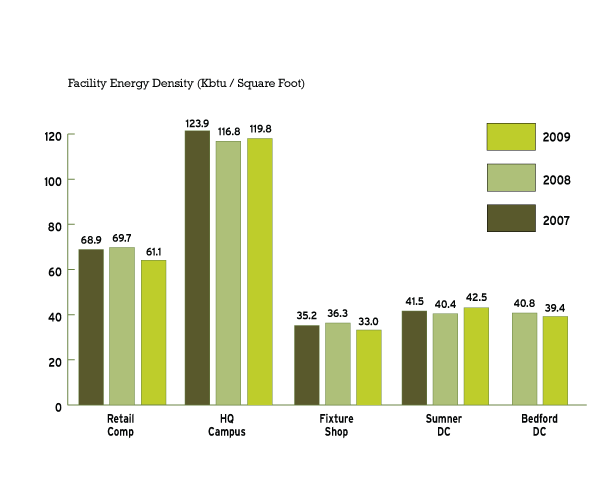
Collectively, they also account for one of their largest environmental impacts and offer opportunities to reduce their environmental footprint. Green building provides an opportunity to address several of their environmental priorities, including energy efficiency, renewable energy and waste reduction.
They strive to create buildings that reflect REI’s mission and values, and they work to integrate sustainable design elements into our new stores and existing buildings. Whether they are retrofitting an existing facility or building a new store from the ground up, their goal is for all REI facilities to be as energy efficient as possible.
They design for next year, and beyond... running all of their buildings to reduce environmental impacts and operating costs.
Is it Possible to Measure Sustainability Within the Retail Industry?
By Leon Kaye | 05.03.2010
At a fundamental level, there’s really nothing sustainable about the retail industry as we know it today. In the United States and abroad, as the economic engine evolved from one of production to one of consumption, retailers and their suppliers have become the dominant companies. Take a look at the Dow Jones Industrial Average: the index showcases companies including Walmart, Home Depot, Kraft, Coca-Cola, and other firms like 3M, Alcoa, Hewlett-Packard, GE, and Walt Disney, which have some role in our consumer-driven economy. The results? A flood of cheap goods, the increased consumption of energy and resources, and, some would argue, lower wages. Nevertheless, more retailers are conscious of their impact on people and the planet, and some are becoming sustainability leaders. But is this concern genuine or simply crass marketing, or even “greenwashing?”
Five Winds International, a strategic environmental consulting firm, released the first in a series of studies evaluating a select group of large retail firms and sets some benchmarks. Companies in this survey include big box chains Walmart and Target, UK-based Marks & Spencer and TESCO, and Whole Foods. Five Winds measured several factors, including logistics, carbon efficiency, green buildings, and how the companies’ employees—and the communities in which they operate—were treated. The results may surprise you, and of course will spark debate.
The way to view Five Winds’ study is that it is a compelling framework by which to benchmark a retail firm’s actions when compared to its words (i.e., the web pages devoted to sustainability and corporate social responsibility). The big winner? Marks & Spencer, chiefly because of its devotion to the greening of the company’s supply chain, energy efficiency, focus on greenhouse gas emissions, water conservation, and procurement policy. Meanwhile, Sears Holdings was considered a laggard, surprising to me considering the efforts the company has made to source more environmentally-friendly paper and its crown as the EPA’s ENERGY STAR Retail Partner for 2010. They survey may not be entirely fair: many of Sears’ and K-Mart’s locations are in older buildings, and with all the turmoil the company has experienced over the past decade, revamping and greening its stores may not be high on the list right now, but is now turning a corner.
happy 2011, and make it greener... let's reflect on our 2010 sustainability goals by measuring the results.
Our ever-growing list of people, places, things, that hit us in a nice way.
www.nau.com... check out some the their influences below (great people are a not-so-secret weapon)
Hella Jongerius
Vintage Dior, YSL, Balenciaga
Peter Zumthor
Copenhagen Cycle Chic
Gerhard Richter
Nerd Boyfriend
GOOD magazine
magic seaweed
Alec Soth
David Burnett
Mt. Hood Meadows snow report
Andrea Zittel
Claudy Jongstra
Juergen Teller
Droog Design
John Singer Sargent
Glitch Mob
Pantone
Vice Magazine
National Park Service
space
we are the product of our experiences... what better way to live & learn, in the new year, than to be inspired by greatness?
Walmart Program Benefits Pets, Pocketbook and Planet
Tim Albinson, 12/20/2010
In an ingenious move that brilliantly illustrates how closed loop systems can benefit both consumers and corporations, Walmart has introduced a new line of pet products that are made from the retail giant’s own recyclable waste materials.
A “closed loop system” uses customer recyclables in the manufacturing process of new products, and in this case, Walmart teamed up with Worldwise, Inc., a leading environmentally responsible consumer products company, to create PoochPlanet and SmartyKat pet products. Using a proprietary processing method Worldwise will make these pet products from the following Walmart materials:
- Bottles are being recycled into dog beds,
- Hangers are being turned into cat litter pans, scoops, and scratchers,
- Bags are being converated into cat littler liners, and
- Corrugated cardboard is being processed into cat scratchers.
“This program will set a new standard for consumers looking for products that are better for themselves, their pocketbooks, and their planet,” said Aaron Lamstein, Executive Chairman for Worldwise. Inc. “We believe this has the potential to spark a revolution in how manufacturers and retailers can work collaboratively to offer better products for its customers.”
Recycling programs such as this one can have an enormous impact. Worldwise estimates that through PoochPlanet pet bed sales at Walmart and Sam’s Club in the next year, Worldwise will keep the equivalent of more than 100,000,000 16.9 oz. plastic bottles out of landfills. This includes the equivalent of approximately 25,000,000 16.9 oz bottles provided by Walmart and Sam’s Clubs.
Of course, Walmart, which has built a reputation as an industry leader in sustainability, also benefits from its partnership with Worldwise.
“This program is the type of innovative thinking that will help Walmart reach its company-wide goals for sustainability,” John Kunkel, Sr. Buyer, Pets for Walmart, said in a statement. “We are committed to creating zero waste and the closed loop partnership with Worldwise is a perfect example of how retailers and suppliers can cooperate to innovate and achieve greater sustainability.”
all good... kudos to these great people helping to make our pets green too!
New Strategies Improve Retailers’ Sales
By Nancy Klosek 12/20/2010
Throughout last year, dealers implemented many different strategies to increase sales, traffic and profits. Here’s a look at what several regional retailers did to improve their merchandising and marketing strategies last year and what they plan to do during the next.
Mark Reckling, CEO/President, Grand Appliance and TV, Zion, Ill: We ran promotions with a lot of green energy products in the appliances sector—mainly using either the states’ monies in the cash for appliances program or manufacturer monies for that segment of the business.
We’ve also expanded our website, with more money spent on Internet marketing and social networking. We are getting buyer inquiries and sales from that source. As print media are becoming less effective, we’ve been transferring our budget in that direction.
In the more rural areas where we market local newspapers are still an effective means of advertising, but in the urban markets we’ve had to turn to the Internet.
Neil Welsch, Vice President, Jeff Lynch, Inc., Greenville, S.C.: We’ve had to re-merchandise our floors at lower price-points because consumers are just not spending as much today because of the economy. Even though as an independent dealer we have better salespeople and better services, price is still a big factor in making the sale. In our advertising and in our floor assortments we’re having to carry a heavier volume of lower-priced goods.
We do not sell on the Internet, although we have a full catalog there of the brands that we carry. We sell by buyer inquiries and we get quite a few of them that translate into sales. As far as merchandising the floor with Internet, we’ve definitely been on top of that and we’ve got the merchandise that consumers are looking for when it comes to those Internet-based products. We show them widely on the floor. We are still getting our hands around Google, as that will have an impact ultimately. From a business standpoint, we are exploring it.
As far as selling online, we’re investing in other directions right now. I think the states need to get control of the revenue being lost through Internet sales. All of our economies—states, cities—are struggling; it’s not fair for companies like us who have invested in their franchise and in all that infrastructure in their marketplace for these Internet companies to be able to ship across state lines and not charge the tax.
bricks & mortar... Marco can help green your business with open space planning, designed for merchandising flexibility
Michael Sauter and Douglas A. McIntyre, 12/20/2010
Slow retail sales and the high unemployment rate this year might make people believe that this is one of the more economically difficult holiday seasons in memory. That is not true because the recession also made the 2008 and 2009 holidays hard for millions of Americans.
People are tempted to spend less when times are tough. Fewer presents are exchanged. People travel less. Those without work often despair. The joy that is supposed to accompany the end of each year does not exist for many people.
24/7 Wall St. compared 2010 against each Christmas since the Great Depression. We looked at unemployment, GDP expansion, GDP per capita, and the Consumer Price Index. These numbers show whether a holiday season was merry or not. High inflation erodes the ability of people to buy things. Slow GDP expansion or contraction means that consumer spending is likely to be in retreat. The effects of unemployment are obvious.
Many of the worst holiday periods coincided with deep recessions. This is certainly true with the harsh times in the downturns in the early 1970s and early 1980s. The 1982/1983 recession had a recorded number of months in which unemployment was more than 10%.
People may look back on 2010 as a difficult holiday season for a number of Americans. But, it was not among the worst, as history shows.
The Ten Worst Holidays Since The Great Depression:
10. 2009
Unemployment: 9.3%
GDP Expansion: -2.6%
GDP Per Capita (Inflation Adjusted): $41,890
CPI: -0.4%
The recession which began with the collapse of the housing bubble in 2008 and continues to affect the American economy was at its worst during this year. 2009 saw a rash of bankruptcies, most notably the Chapter 11 filing of Chrysler, as well General Motors, long considered one of the great American blue chip companies. In this year, Barack Obama was sworn into office, and a national average unemployment rate of 9.3% the highest the country has seen in more than a quarter century.
9. 1958
Unemployment: 6.8%
GDP Expansion: -0.9%
GDP Per Capita (Inflation Adjusted): $14,802
CPI: 2.8%
The recession of 1958 created one of the few difficult economic climates during the post-World War II boom, and the first major one since the Great Depression. In the previous year, car sales had declined 31%, wreaking havoc on the American auto industry. In Detroit, unemployment rates reached 20%, and Packard, venerable automaker, ceases operation. Unlike most previous recessions in U.S. history, 1958 also saw a rise in consumer prices, severely hindering the purchasing power of Americans during the holiday season.
8. 1981
Unemployment: 7.6%
GDP Expansion: 2.5%
GDP Per Capita (Inflation Adjusted): $26,030
CPI: 10.3%
1981 marked the beginning of the early 1980′s recession, during which the Fed raised key interest rates in the hopes of slowing rampant inflation. Inflation continued to rise, however, and the economy entered a period of stagflation. In one of the defining moments in the history of labor, 12,000 Air Traffic Controllers strike over a pay dispute. After refusing to return to work, President Reagan fired them all. An assassination attempt was made on Reagan’s life, as well as in Pope John Paul II during this year. Walter Cronkite, the most trusted man in America, retires after 44 years of journalism.
7. 1974
Unemployment: 5.6%
GDP Expansion: -0.6%
GDP Per Capita (Inflation Adjusted): $22,861
CPI: 11%
The United States continues to face record oil prices as a result of an embargo by OPEC (Organization of Arab Petroleum Exporting Countries) beginning the previous year. The energy crisis was only one component affecting Consumers. Mounting costs from the Vietnam war, as well as a stock market crash after the collapse of the Bretton Woods monetary relation led to the first GDP contraction in 16 years. In this year, President Nixon is impeached after the Watergate scandal.
6. 1946
Unemployment: 3.9%
GDP Expansion: -10.9%
GDP Per Capita (Inflation Adjusted): $12,676
CPI: 8.3%
With the conclusion of the war and the return of millions of soldiers, a shortage of housing and consumer goods leads to a dramatic increase in prices and business costs. The United States begins testing nuclear weapons in the Bikini Atoll, signaling the commencement of the Cold War and nuclear arms race. “It’s A Wonderful Life” – a film about appreciating life in the face of financial hardship – opens five days before Christmas. The film is considered a box office flop.
5. 1947
Unemployment: 3.9%
GDP Expansion: -0.9%
GDP Per Capita (Inflation Adjusted): $12,324
CPI: 14.4%
The United States begins the Marshall Plan, devoting roughly 2% of American GDP to rebuilding war-ravaged Europe in the hopes of strengthening the West against the growing threat of Communism. Problems with inflation continue to worsen, and the Consumer Price Index rises 14.4%, the largest annual increase in recorded U.S. history, before or since.
4. 1980
Unemployment: 7.1%
GDP Expansion: -0.3%
GDP Per Capita (Inflation Adjusted): $25,640
CPI: 13.5%
In 1980, massive inflation and a dive in GDP leads to an increase in unemployment which would continue essentially unchecked until its peak in 1982. Discontent as a result of the recession leads to the election of Ronald Reagan as president in November. U.S. personal bankruptcies increase 47% to 367 thousand. An attempt to rescue prisoners held during the Iran Hostage Crisis fails. John Lennon is shot and killed outside of his New York City apartment.
3. 1949
Unemployment: 5.9%
GDP Expansion: -0.5%
GDP Per Capita (Inflation Adjusted): $12,365
CPI: 1.3%
The American economy contracts, producing the first decline in consumer prices since the Great Depression. The price of housing and health care, however, goes up. The Soviet Union tests its first atomic bomb.
2. 1975
Unemployment: 8.5%
GDP Expansion: -0.2%
GDP Per Capita (Inflation Adjusted): $22,592
CPI: 9.1%
The global economy suffered heavily from continued stagflation, with countries like the U.K. experiencing inflation rates of close to 25%. In the first quarter of the year, the U.S. sees GDP drop 4.8%. A stagnant economy increases wages, resulting in mass layoffs, and the highest unemployment rate since 1941. New York City nearly goes bankrupt after the Federal Government refused to bail it out, producing the now-famous Daily News headline “[President] Ford to City: Drop Dead.” Ford eventually gives in, loaning the city $2.3 billion.
1. 1982
Unemployment: 9.7%
GDP Expansion: -1.9%
GDP Per Capita (Inflation Adjusted): $25.282
CPI: 6.2%
1982 sees the worst of the early ’80′s recession, as unemployment rises above 10%, including a 10.2% rate for the month of December.
poised for a rebound... will this year provide momentum for a 2011 recovery?
Green retail: saving the planet can save on costs
No doubt about it: the economic downturn has caused consumers to cut back on spending. The retail industry is looking for new and innovative ways to cut costs even while encouraging consumers to increase the frequency and the size of their purchases. There's one move that has proven effective in both reducing costs and driving consumer demand: going green.
Green retail delivers business sustainability. It's a way to demonstrate corporate social responsibility by reducing the environmental impact of an enterprise while simultaneously delivering significant financial benefits. In short, what began as an initiative to improve our planet's health has evolved into a means of boosting profit margins. These efforts can offer significant benefits to businesses by:
Reducing the amount of energy used by data centers and point of sale (POS) terminals, lowering carbon emissions and slashing operating costs.
Optimizing the supply chain, which helps reduce waste, increase flexibility and tighten control of product delivery and demand-response time.
Migrating to green infrastructure, which provides an opportunity to re-evaluate operations for improved efficiency and to help locate surplus expenses.
Implementing green operations that can improve compliance with government regulations—now and in the future.
All of these advantages can produce a business that’s leaner, stronger and more competitive—without lowering prices. Going green can do wonders for a company’s brand. In fact, even as they seek to limit their spending, consumers continue to seek out brands and products that reflect their social concerns. Clearly, environmentalism remains a major priority. As evidence, given the choice between similar products, many customers will choose—and even pay a premium for—the one that is quantifiably better for the environment.
green your bottom line... Marco Eco-Built is designed to help manage your business goals, both environmentally & ecologically
Goodbye, Best Buy. Hello, specialty retail?
JP Mangalindan, 12/14/ 2010
Most times of the year, Best Buy's foot traffic tends to be healthy -- the chain plants its stores in areas where heavy volumes of customers are not hard to find. But during the holiday shopping seasons, all bets are off as throngs of people line up despite frigid temps at 4 a.m and limited parking. Customers wheel out of the store hours later with multiple flat screen TVs, PCs, games and other electronic paraphernalia. In fact, some families actually gear their holiday shopping towards the Best Buy Black Friday experience.
It was both magical and painful. The adrenaline rush and deals seemed worthwhile. But waking up at 4 a.m. and parking hundreds of yards away on the grass -- the parking lot was always full -- only to race against irate, pumped-up soccer moms for an extremely limited supply of in-stock products? Not so much.
Since then, our shopping habits have changed, as it seems have those of many other families, too. Regardless of the time of year, Best Buy isn't a must-visit for us, anymore. If we want specific items -- a new phone, a tablet, ereader -- we go directly to the source: an Apple (AAPL) store for a MacBook, an AT&T (T) store for most phones, or Amazon (AMZN) for the Kindle. While Best Buy did say their sales of newer gadgets like smartphones and tablets were doing well, it was weak television and laptop sales that actually brought their figures down. One could argue that even so, consumers choosing to shop elsewhere for a new television also deprived Best Buy of knock-on revenue from additional tablet and phone sales.
In some cases, the deals for gadgets simply aren't as competitive as Best Buy's, but oftentimes, they are. (Best Buy doesn't offer discounts on any Apple products, for instance.) I actually prefer going to the Apple store to Best Buy because, unless you're subjecting yourself to the madness of Apple's Fifth Avenue New York City location, the customer service is oftentimes superior. Employees usually know more about the products they're talking about because they're not responsible for stocking and overseeing hundreds of thousands of electronics that may include televisions, stereos, computers, games, vacuums and smaller tchotchkes. In a more specialized retail store, employees have a smaller product catalog to learn about, which likely enables a better understanding of the products, and a better customer experience.
So does all this mean Best Buy's days of ruling the retail roost are over? Could it go the way of Circuit City, into bankruptcy and oblivion? Hardly. The business seems too well managed, and there are too many places in the country where specialty shops are scarce and big box stores are plentiful. But Best Buy's bad results do probably mean that consumers are getting a better idea of what tech gear they want, and a better idea of where and how they want to go about getting it.
With the big box consumer gadget chain's revenues down, it seems shoppers are heading to specialty stores or online to get their goods.
Marco Contractors Doubles Down with Revenue Streams
Tim Schooley - 12/10/2010
After decades as a general contractor, Marty Smith
knew the foundation of his business could use extra support.
Smith started a construction company in the 1970s when he didn’t even know how to build so much as a dog house, but Marco Contractors has generated a strong list of major retail clients, building stores and restaurants throughout the country. The company now has a staff of more than 200 employees and revenue that has reached as high as $40 million to $50 million.
Yet Smith is aware stores close as well as open, contract as well as expand. “I always wanted to have different revenue streams so, if one failed, it could pick me up,” he said.
That’s what has happened through the latest downturn, which led retailers to stall plans to open new locations while often cutting back on the number of stores. Revenue at Marco has dipped to around $35 million as Smith has worked harder to generate more business.
At the same time, Smith’s Rockerz Inc., a firm incorporated in the mid-1980s but ramped up around 2002, finds itself busy serving a similar client base, providing them with flooring made from ground and polished concrete.
Using the leverage and resources of his larger contracting firm, Smith said Rockerz has been experiencing double-digit annual growth because it can more cost-effectively compete.
“We’re cheaper in the long run for a lot of national retailers because we do both,” he said.
The new flooring is a value proposition, giving retailers a flooring technique that is LEED-certifiable and can help save on heating and lighting costs with a reflective finish while improving the overall shopping experience by creating a brighter store. Rockerz flooring, which is long-lasting, was used at Giant Eagle’s Market District store at Settlers Ridge in Robinson Township and such retailers as Family Dollar and Dollar General, among others.
While retailers may not be opening as many new stores, they often are looking for ways to save money on established ones.
“Keep in my mind: We’re not talking about one store,” Smith said. “You can save them $10,000 a store on floors.”
Rockerz has ramped up to more than 50 employees and has been experiencing 25 percent to 30 percent annual growth at the same time Smith said Marco’s business trajectory has been going in the opposite direction.
While Marco continues to be profitable, Smith said it’s a challenge to juggle the demands of both businesses with those of Planet Pulse, his casual clothing store in Cranberry, which just opened a second location at Settlers Ridge.
“You’re constantly trying to find balance,” he said, noting that each business faces different needs. “I’ve got to find the right overhead to commit to the right amount of revenue to make sure that my bottom line is healthy.”
Whether it’s Marco licensed to work in all 50 states, Rockerz’s green flooring or the merchandise mix at Planet Pulse, Smith strives to make each business stand out.
Nike Environmental Design Tool
Nike is releasing its Environmental Apparel Design Tool with supporting data and methodology for public review. We hope by sharing this knowledge it will accelerate collaboration and encourage broader adoption of sustainability principles. The Tool evaluates waste, energy, toxics and water in materials and manufacturing, enabling companies to affect the most significant components of a product’s environmental impact. It is a beginning; a building block from which something better can be created. We welcome your collaboration. The more that our industry works toward a common goal, the more likely we are to develop scalable, viable environmental solutions.
For more information on Nike sustainable business and innovation, please refer to the Corporate Responsibility Report. In addition, Nike will be hosting webinars to further explain and demonstrate the capabilities of the Environmental Apparel Design Tool.
collaboration is key... let's work together to build a sustainable retail economy
Fair trade stores growing in cachet in North Jersey
BY JIM BECKERMAN, 12/08/2010
Every item in Fair World After All, an Englewood fair trade gift shop, has a story: handbags, bracelets, vases, gloves, chafing dishes, lampshades. And Thek knows them all.
"A couple of years ago there was a big drought in Kenya," she says. "The Maasai men would leave the women and children to go out herding goats and whatnot. So the women staying back had to find another source of income. A group of them work on these necklaces."
Here's a green and white bag, one of Thek's favorites. It's made of cotton thread woven with recycled cassette tape — you can see it glisten — and comes from a vocational organization in New Delhi. "They focus on children and young adults that have developmental or physical disabilities," she says.
Try going into a big chain store and asking the back story of one of their handbags.
Not only would the clerk not know but — if the words "made in China" or "made in Mexico" appear on the label — it might be tied to some sordid story of child exploitation or underpaid factory workers.
That's why "fair trade" has become a buzzword in progressive circles, and fair trade stores like Thek's are popping up across the country and around the world.
So much so, in fact, that the neighboring town of Teaneck has taken the next step. On Oct. 21, following a May vote by the township council and under the auspices of Fair Trade Towns USA, Teaneck officially became one of 21 fair trade towns in the U.S. (three others are in New Jersey: Montclair, Highland Park and Red Bank).
"It's a very exciting development," says Bruce Prince, owner of Teaneck General Store, which carries a large selection of fair trade goods: jars, mirrors, clocks, candles, cooking utensils, coffee, tea.
green your inventory... it's not just about your bottom line, but also about living wages for production of goods
People want to touch items before buying
12/06/2010
Research indicates that people deter from online shopping because they want to see the items beforehand. Forty-five per cent of people said that they like to touch the items before making a decision to buy.
This comes as bit of a blow when today is expected to be the busiest day for online shopping. Dubbed Mega Monday, e-retail industry IMRG expects more than £0.5 billion to be spent on the web.
Twenga, the search engine which enables shoppers to look in one place for everything they want, conducted the annual Christmas shopping survey and asked internet users what reasons would prevent them from buying online.
Therese Torris, Vice President of Content at Twenga said: “E-Retailers have got the message – free return offers are very popular, so that customers can can touch the product or order two or three different sizes to try the product and choose the one they like.”
It also showed that 29 per cent of shoppers are worried that the products they buy will not match the description given.
David Smith, Managing Director at IMRG, told Retail Gazette: “2010 looks set to be another bumper year for online, with sales for Super Sunday and Mega Monday estimated to reach over half a billion at the end of a week when the festive spend really kicks in.
“Consumers have looked to spread the cost of Christmas a bit more this year due to the economic climate, but December 6th is the day that our retailers expect sales activity to be at its highest.”
bricks & mortar... connect with your customers online and invite them to visit in person for the human touch
Zero Landfill
ZeroLandfill™ Co-founder, Jeff Krejci, began in 2004 to pick up expired carpet specification books and recycle during sales calls. The books would get broken down into the separate recycling streams. The carpet samples were shipped to InterfaceFLOR for recycling and the cardboard books were recycled locally. Mike Dungan, Amanda Dempsey and Krejci met to come up with a better way.
In 2006, ZeroLandfill™ began in the back parking lot of a furniture dealership in Cleveland, OH. What initially began as a recycling effort, quickly turned into a community reuse project. Christy Gray observed that artists and educators would love the materials.
Discovering the value of the materials to the creative community, the ZeroLandfill™ project team invited artists and arts educators to harvest materials for their own projects and educational materials. Over 300,000 lbs. later, ZeroLandfill™ program fills the gaps for educators material needs and creates behavior change for architects and interior designers as what was formally considered waste is redirected into the community.
next project site... Pittsburgh is meeting today to launch our program & Marco will help
E-Commerce, Discount Stores Dominate Recovery In Retail Sales; Broad Implications For Retail Real Estate
Marcus & Millichap, 11/24/2010
Core retail sales fell steeply between mid-2008 and mid-2009 but have since staged a recovery to pre-recession levels, with further gains anticipated through the holidays. Despite this consumption recovery, vacancy rates at retail properties remain significantly higher than the levels recorded prior to the recession. This reflects record store closures and the housing-inspired run-up in retail construction. Hundreds of millions of square feet were delivered just as consumers pulled back, but a dramatic shift in consumer behavior also impacted vacancy trends. While monthly core retail sales have surpassed previous peak levels, nearly one-third of the recovered gains have come from e-commerce. Since the trough in monthly retail sales in December 2008, online retail sales climbed nearly $5.6 billion at the expense of many traditional retailers. Drugstores, grocery stores, and restaurants and bars also account for outsized shares of the increase, while clothing stores, building supply dealers and furniture retailers posted the weakest gains.
The recession has given way to a structural shift in shopping behavior that could change the retail landscape for years to come. As job losses mounted and budgets tightened, consumers became more price-conscious, and many discovered lower-price alternatives, such as discount chains and online stores. As the economic recovery gains momentum, consumers may have little incentive to revert to previous shopping habits. While major discount chains will continue to expand, more mom-and-pop retailers, which have already lost sizable market share, will be pushed to the edge. Marginal chains and those that fail to offer a competitive advantage to brick-and-mortar powerhouses or Internet-based services, such as movie rental chains or music stores, will also face steep challenges.
business as usual is over... let's move into a more sustainable future with green retail strategies